MLB: The Conditions Game
A systematic 4-step framework for analyzing every MLB player prop
Every MLB prop is shaped by a stack of conditions. Read them in order — the arm, the matchup, the environment, the number. Bet when the conditions align and the market hasn't caught up.
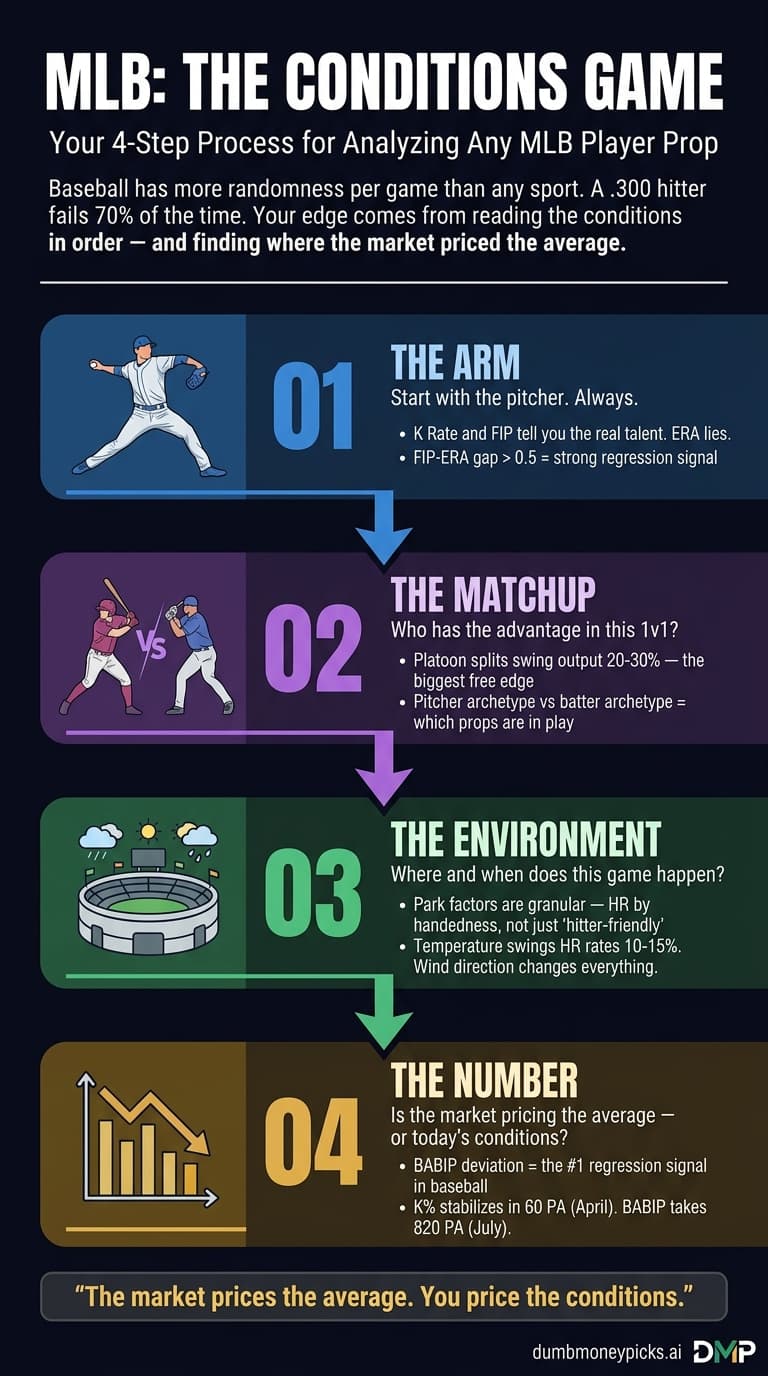
The Framework Explained
The Arm — Start With the Pitcher
The pitcher controls the game. For pitcher props, he IS the subject. For batter props, the opposing pitcher is the obstacle. This is the universal entry point for every MLB prop.
What to look at
Why FIP, not ERA? ERA is contaminated by defense quality and luck on balls in play. FIP isolates what pitchers actually control: strikeouts, walks, and home runs. The FIP-ERA gap is one of the most reliably predictive signals in sports betting.
Key stat: K% stabilizes in ~70 batters faced — reliable from Opening Day
The Matchup — Where 20-30% Swings Hide
Baseball is the only major sport where every stat is a discrete 1-on-1 event. Platoon advantage (left-handed hitter vs right-handed pitcher and vice versa) can move expected output by 20-30%.
What to look at
Platoon splits are the single biggest free edge in baseball props. A .280 hitter overall might hit .310 against opposite-hand pitchers and .230 against same-hand. The market often prices the overall line without fully adjusting.
The Environment — What Makes MLB Unique
No other sport has first-class environment variables that can swing prop outcomes by 15-30%. This is what makes baseball analysis fundamentally different from basketball or football.
What to look at
Park factors aren't just "hitter-friendly" or "pitcher-friendly." Yankee Stadium inflates left-handed HR but is neutral for righties. Petco suppresses doubles but is average for home runs. You need granular factors by handedness and hit type.
Key stat: Temperature alone can swing HR rates by 10-15%. Wind direction at Wrigley turns it into a different ballpark.
The Number — Is the Market Pricing the Average?
The market always prices the matchup. Your edge is everything else: the environment it missed, the regression it hasn't adjusted for, the platoon advantage it averaged over.
What to look at
When you see a player batting .350 in April, your first question should be: "What's his BABIP?" If it's .400, that's luck — not skill. It WILL come down. The market prices the hot streak. You price the regression.
Key stat: K% stabilizes in ~60 PA (April). BABIP takes ~820 PA (late July). Knowing the difference is a structural edge.
How It Applies to Every Prop
| Prop | The Arm | The Matchup | The Environment | The Number |
|---|---|---|---|---|
| Pitcher K | K rate, FIP | Lineup K tendency | Park K factor, umpire | Line vs projection |
| Hits | Opposing K%, WHIP | Platoon, contact rate | Park, lineup position | BABIP regression |
| Total Bases | Opposing FB%, HR/9 | ISO, barrel rate | Park HR factor, wind | xSLG vs actual |
| Home Runs | Pitcher HR/FB | Power + platoon | Park + weather stack | Price vs probability |
| Batter K | Opposing pitcher K% | Batter K%, platoon | Park, umpire | Cleanest April signal |
The Stabilization Calendar
Not all stats become reliable at the same time:
K props (K% stabilizes ~60 PA). HR via barrel rate.
Add hits, total bases (ISO stabilizes ~160 PA)
Full confidence across all prop types
Frequently Asked Questions
Ready to start researching?
Open the Plus EV props table and apply the framework