NBA: The Redistribution Game
A systematic 4-step framework for analyzing every NBA player prop
The Core Insight
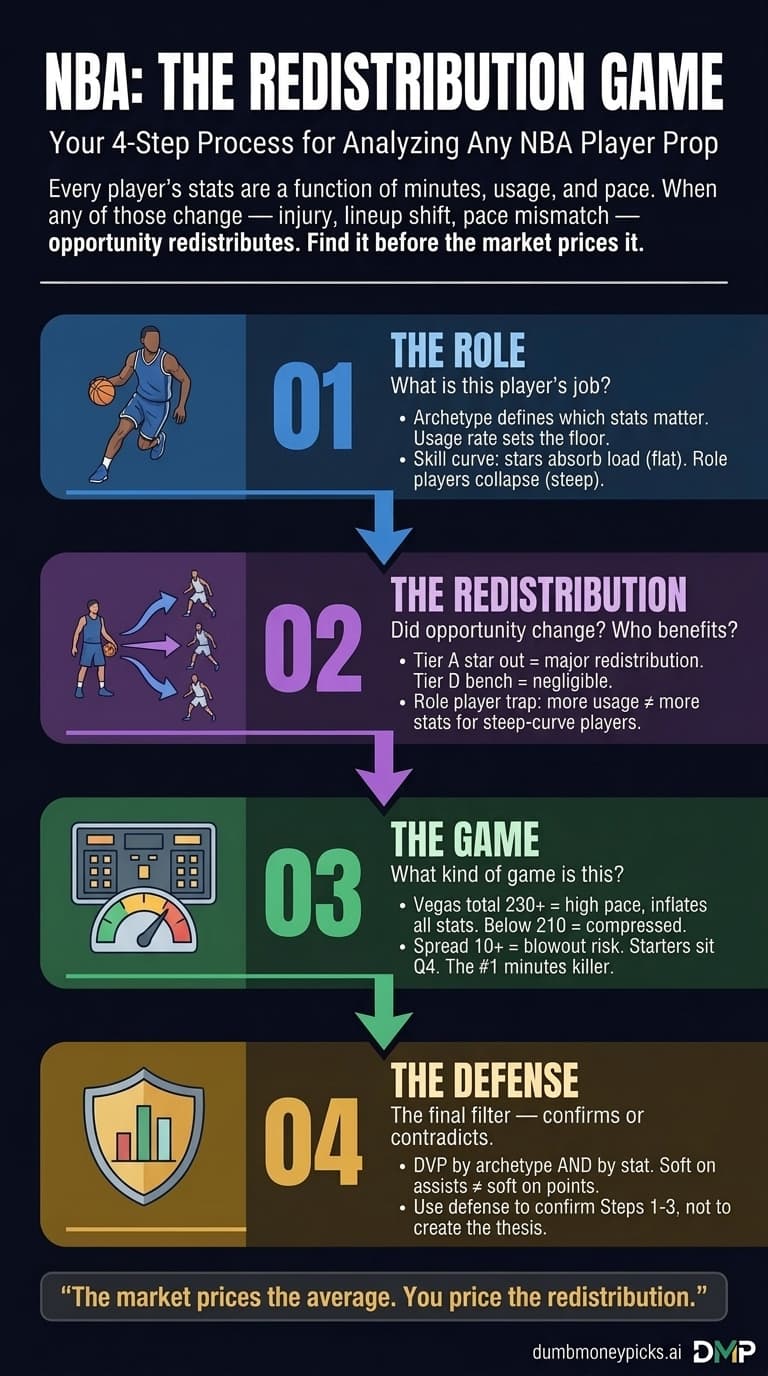
"Every player's stats are a function of minutes, usage, and pace. When any of those change — injury, lineup shift, pace mismatch — opportunity redistributes. Find it before the market prices it."
The Framework Explained
The Role — What Is This Player's Job?
Before you can analyze redistribution, you need to know the baseline. A player's archetype defines their statistical fingerprint — a Floor General produces assists differently than a Volume Scorer produces points.
What to look at:
- Player archetype
- Usage rate
- Minutes stability
- Skill curve (flat vs steep)
Skill curves are the most important concept: stars with flat curves (LeBron, Jokic, Curry) absorb extra possessions with minimal efficiency loss. Role players with steep curves collapse under higher usage — their volume increases but efficiency drops faster.
Key stat: Usage rate is the #1 input for points props. 30%+ = elite scorer with a predictable floor.
The Redistribution — Did Opportunity Change?
This is the core of the NBA framework and where the biggest edges hide. When a star sits, their usage doesn't disappear — it redistributes to specific archetypes predictably. The market reprices the star and the obvious next option, but secondary beneficiaries stay mispriced for hours.
What to look at:
- Injury tier (A/B/C/D)
- New vs established (10+ games = priced in)
- Redistribution flow (primary, secondary, minutes beneficiary)
- Skill curve check
The tier system quantifies impact: Tier A (30+ MPG, high usage) = major redistribution. Tier D (deep bench) = negligible. Multiple Tier D absences do NOT equal one Tier A.
Key stat: Established absences (10+ games) are fully priced in. Only NEW changes create edge.
WARNING: The Role Player Trap
More opportunity does NOT automatically mean more stats. When a star sits and a role player gets more usage, the market sees opportunity. But role players have steep skill curves — efficiency collapses with higher usage. A role player getting 5% more usage typically converts only 50-70% of the expected stat boost. This is the #1 misconception in NBA prop betting.
The Game — What Kind of Game Is This?
The game environment determines how many possessions exist and how long starters play. A high-pace shootout creates more opportunity than a defensive grind.
What to look at:
- Vegas total (pace proxy)
- Spread (blowout risk)
- Game script
- Minutes stability
A redistribution boost in a high-pace game (total 230+) compounds. In a low-pace grind (total <210), even elevated usage produces fewer stats. Blowout risk (spread 10+) is the #1 minutes killer — starters may sit Q4.
Key stat: Vegas total is your best pace proxy. 230+ = high pace, <210 = low pace.
The Defense — The Final Filter
Defense vs. Position (DVP) is the noisiest signal in the framework — use it to confirm a thesis, not create one. But per-stat DVP by archetype is more actionable than overall team defense.
What to look at:
- Per-stat DVP (PTS, REB, AST, 3PM separately)
- Archetype-specific DVP
- Defender injuries
- Defensive scheme
A team can be tough on points but soft on assists. When all 4 steps align — role supports it, redistribution creates it, game amplifies it, defense confirms it — the edge is most durable.
Key stat: DVP is a confirmation tool, not a thesis generator. Use it to validate, not to discover.
How It Applies to Every Prop
| Prop | The Role | The Redistribution | The Game | The Defense |
|---|---|---|---|---|
| Points | Usage rate, scorer archetype | Star out → who absorbs scoring? | Pace, blowout risk | DVP for PTS by archetype |
| Assists | Ball handler, potential AST | Handler out → secondary initiator | Pace, game script | TO-forcing defenses suppress |
| Rebounds | Position/size, scheme | Big out → glass available | Misses create boards | Opponent crash rate |
| 3PM | 3PA volume, spacer archetype | Scorer out → more looks | Trailing = more 3s | Perimeter D quality |
| Combos | Multi-category fit | Expanded role lifts all stats | Pace amplifies all | Per-stat DVP for each |
Frequently Asked Questions
What is the NBA Redistribution Game framework?
The Redistribution Game is DMP's systematic 4-step approach to analyzing NBA player props. Every prop is evaluated through: The Role (player archetype, usage, skill curve), The Redistribution (how opportunity flows when players sit), The Game (pace, blowout risk, game script), and The Defense (DVP by archetype and specific stat). The core insight: when opportunity changes, stats redistribute predictably.
What is redistribution in NBA betting?
Redistribution refers to how a player's statistical opportunity (usage, minutes, shot attempts) flows to teammates when they are absent. When a star with 30% usage sits out, that usage redistributes to specific archetypes predictably. The primary beneficiary is usually the next-highest usage player at the same position. Secondary beneficiaries and minutes beneficiaries are often overlooked by the market, creating betting edges.
What is the role player trap in NBA props?
The role player trap occurs when the market overvalues a bench player's OVER prop after a star injury. Role players have steep skill curves — when given more usage, their efficiency collapses (harder shots, more turnovers). A role player getting 5% more usage typically converts only 50-70% of the expected stat boost. DMP flags this by checking each player's skill curve dampening factor.
How does pace affect NBA player props?
Pace determines the total number of possessions in a game, which directly caps stat ceilings. The Vegas total (over/under) is the best proxy: 230+ total = high pace (~103 possessions per team, inflates all stats), below 210 = slow pace (~93 possessions, compresses everything). A redistribution boost in a high-pace game is bigger than the same boost in a defensive grind.
What is DVP in NBA betting?
DVP (Defense vs. Position) measures how a team's defense affects opposing players at a specific position or archetype. DMP uses per-stat DVP by archetype — separate softness percentiles for points, rebounds, assists, and 3PM against each archetype type. A team can be tough on points but soft on assists. DVP is best used as a confirmation tool (Step 4), not a thesis generator.
Ready to start researching?
Apply the framework to today's NBA props